





|
 |
 |
Ranch History
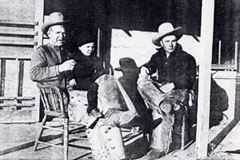
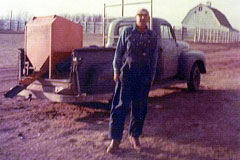
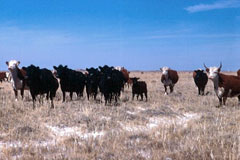
The Dunne Valley Ranch is located in the Cimarron Valley in Southwest Kansas along the Oklahoma border. It is 10 miles south of Ashland, the Clark County seat. This history attempts to place the Dunne Valley Ranch into known historical context. Errors of fact are the sole responsibility of the author. – D. Dunne Early Settlers in the Cimarron Valley In the era of the great cattle drives, the Cimarron River Valley in Kansas and Oklahoma lay along the western arm of the Chisholm Trail, also known as the "Great Western Trail" or the "Dodge City Trail." According to historians, the trail crossed into Kansas about 4 miles east of where the Cimarron River traverses the border, which would place the trail near the southeast corner of the Dunne ranch. From 1876 to 1885 over 2,000,000 cattle passed along the trail, but the cattlemen, along with the cattle, were mostly transient visitors to Clark County. An enterprising cowboy, on the other hand, with an eye for good cattle country, might think he could make a living in this largely unsettled land. 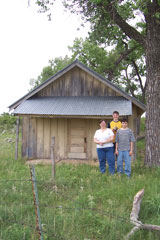 The Duck Shack in 2004; it has since burned down. Permanent residents began to trickle into the Cimarron Valley in the mid 1870’s. Clark County was created by the US legislature in 1867 and remained an “unorganized county” due to its small population. However, in 1883, the county was annexed to Ford County so that the big ranches along the Cimarron could be taxed. Needless to say, this did not please the ranchers. It is said that the large ranches in those days were sometimes put together by urging the hired men to prove claims in the desired areas. This was done by paying $10 and putting up a building - often a simple sod dugout. Once they were proved up, the claims were then “sold” to the boss. Shenanigans of this sort may have occurred all over cattle country, but in Clark County at least, the 1880 census indicates that the cowboys lived on the same premises as the “stock farmers”, as the cattlemen were called in those days. A small cabin south of ranch headquarters, known to later Dunne generations as the Club House” or “duck shack”, was said to be an original homestead. In 1884, the Ashland Clipper had this to say: "The immigration into this county from the east does not seem to abate because of the approach of winter. The wagons still pour into the valleys south, southeast and southwest of here at a rate never before equaled, and we expect to see them continue to come all winter. . . . If you have not used your right of preëmption, wait no longer, as in all probability it will soon be forever too late."This “right of preemption” implies that the claims of these very early ranchers were grandfathered into the system. One of the larger ranches in the county was established along Keiger Creek by man named Evans. This man Evans, though we don’t know much about him, was likely the first settler of what later became the Dunne Valley Ranch. The Campbells James Preble Campbell acquired the property in 1899. Mr. Campbell, by all accounts, was a dedicated and successful rancher - success being due in part to the judgment he used in forming a capable crew. Campbell's foreman for many years was a man named Alonzo (Lon) Ford. Lon's brother, Emmett, worked for the famous rancher from Texas, Charles Goodnight (according to Alonzo's son Henry), proving a tenuous link between the two cattlemen. Whatever the extent of this link, J.P. Campbell and the Ford brothers were no doubt aware of some of the early cattle breeding practices that Goodnight pioneered, and may very well have brought these practices to the Campbell ranch. Goodnight is known to have crossed longhorns with herefords, and buffalo with cattle, which he called "Cattalo". Though speculative, this may account for the presence of buffalo on the Campbell ranch in the 1920’s.. 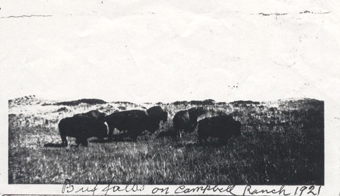 Bison on the ranch in 1921. Sitting on the porch of the Campbell's bunkhouse. The Dunnes and Hoffmans Excerpt from Almost A Cowboy; self-published and printed by the author, Myron Lee Newell in 1994. Dub just sat there on his horse taking in all the horse training. When the dust settled and I stopped being stupid, Dub rode in and cut the cow out for, hopefully, the last time. He turned his horse and came riding over towards me. Every time his pony took a step in my direction I shrank a little. By the time he stopped in front of me, I had practically disappeared. I would have given a year’s wages to have been able to do so. He sat there for a few moments just letting me dig my grave a little deeper, if I was so inclined. As it turned out I was. He said, “You certainly are having quite a time with your horse today.” I sat right up in the saddle quick like and fussed my horse around some, then, like a damn fool, I said, “Yes, sir, he sure isn’t into it today and needs a lot more training before he really will be handy at holding.” See I told you I wasn’t really thinking or responding intelligently. I guess that was just more than even Dub could handle. He dropped his head and just stared at his saddle horn for some time. He finally looked up at me and said, “There is one thing you have to remember when it comes to training horses. It is difficult to teach the horse anything if you’re not smarter than the horse.” I thought about that for a while but the sun on my hat was just too hot! Wichita businessman Glen Murray Dunne, in partnership with his friend, Texas oilman George Hoffman, purchased the ranch after J.P. Campbell’s death in 1941. Glen lived in Wichita, but had deep roots in southwestern Kansas. He was the son and grandson of pioneers who settled in 1884 in Comanche County, just to the east of Clark County. As a teenager, in the years prior to the First World War, Glen worked on his uncle's farm in the Protection-Coldwater area. It was then that Glen developed an abiding attachment for the southwestern Kansas prairie and the ranching life. Years later, when Glen heard that the Campbell ranch was for sale, his dream of owning a ranch near his grandparents’ homestead became a reality. The Dunne-Hoffman ranch was managed from Main Headquarters, with Glen and Mr. Hoffman alternately occupying the main ranch house whenever they could get away from other pressing business. As in the past, day-to-day operations on the ranch were handled by the foreman, who lived with his family in the “boarding house” behind the main ranchhouse. In the early 1950's the boarding house was torn down and the current foreman's house was built in the same location. Around the same time, a sun room was added to the main house. Ranch hands lived in the bunkhouse behind the foreman's house. One of those young men, Myron Lee Newell, went on to write a humorous, book-length memoir called Almost a Cowboy, which revisits his life in the early 1950’s when he worked on the Dunne-Hoffman ranch under the foreman Dub Good. In the late 1960's Glen bought out his partner, and the Dunne-Hoffman Ranch became the Dunne Valley Ranch. For a number of years after Glen's death in 1978, his son Jack continued the cow-and-calf operation in partnership with a neighboring rancher. Since Jack's retirement from the ranching business, the ranch has been leased. The family, meanwhile, has continued to take an active interest in the property: In recent years, the main ranch house, the foreman's house, west headquarters and other ranch buildings have undergone renovations or re-modeling, complementing improvements to the pastures, fencing and watering facilities (see Improvements). |